Malawi’s drive to attract foreign investment faces mounting pressure as developing economies are falling behind advanced countries in attracting foreign direct investment (FDI), the United Nations (UN) has said.
According to the United Nations Conference on Trade and Development (Unctad) World Investment Report 2026 published on Tuesday, FDI flows to developing economies, including Malawi, increased by two percent to $901 billion in 2025, while flows to developed economies rose by 22 percent to $785 billion.
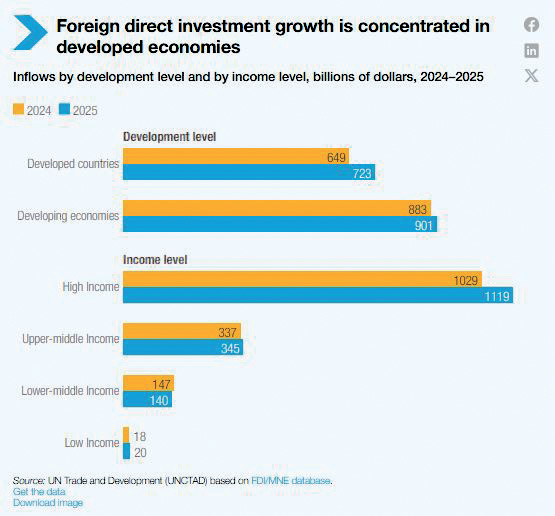
The data also shows that Africa recorded a 25 percent decline in FDI inflows to $70 billion in 2025 from $94 billion the previous year, signalling a more difficult investment environment for countries in the region, including Malawi.
This is coming at a time investment is increasingly flowing into strategic sectors such as digital technology, clean energy and critical minerals.
Ironically, the developing countries received only about 10 percent of global investment in these strategic sectors despite accounting for about 16 percent of global gross domestic product.
Reads the report in part: “Developing countries need more than investment promotion to compete in this environment.
“They need realistic entry points into evolving value chains, stronger investment facilitation, reliable infrastructure, workforce skills, supplier development and regional markets that make projects more viable.”
Prospects for 2026 remain difficult. Trade policy uncertainty, geopolitical tensions, conflicts, high financing costs and economic fragmentation continue to weigh on investment decisions.
Export Development Fund (EDF) also shows that despite registering moderate gains, Malawi’s FDIs remain below the 10-year average and fail to show consistent momentum in attracting sustainable capital.
According to the data, after a peak of $408 million (about K714 billion) in 2015, inflows dipped to $55 million (about K96 billion) in 2019, before partially recovering to $220 million (about K385 billion) in 2024.
Malawi Confederation of Chambers of Commerce and Industry (MCCCI) director of business environment Lucky Mfungwe observed that the difficult operating environment continues to discourage both domestic and foreign investment and slow economic transformation.
He said: “Malawi’s investment climate continues to be constrained by persistent foreign exchange shortages, high inflation, elevated interest rates, unreliable energy supply and an unpredictable policy and regulatory environment”.
In its recent Country Private Sector Diagnostic Report, the World Bank said Malawi has one of the lowest investment rates in the region in part due to exogenous factors.
The global multilateral lender said Malawi’s landlocked status, small population and minimal purchasing power make attracting foreign investment a challenge.